
Understanding Fiber Blends in Hotel Linens
Choosing the right fiber blend matters for both guest comfort and linen performance. Hotel sheets must stay soft, resist repeated high-temperature washes, and keep a clean, crisp look. Here is a simple guide to the most common blends used in hospitality.
How Fiber Blends Work
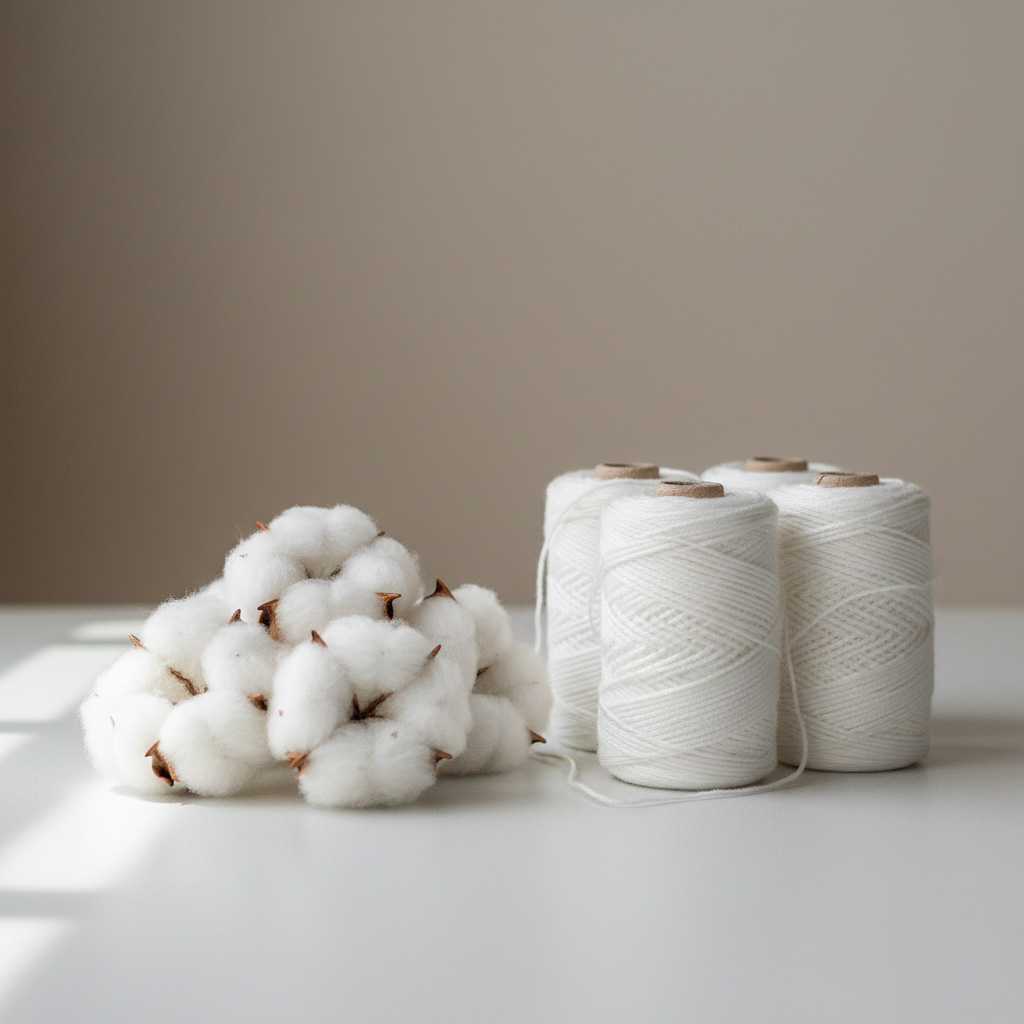
Cotton provides softness, breathability, and a natural feel.
Polyester improves durability, wrinkle resistance, and shape retention.
The right blend balances guest comfort with operational efficiency.

Main Blends in Brief
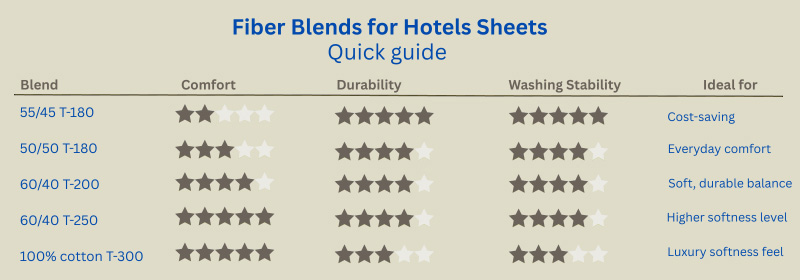
55% Cotton – 45% Polyester | T-180
Durable, cost-efficient, ideal for high-demand operations.
50% Cotton – 50% Polyester | T-180
Balanced, easy-care comfort for everyday use.
60% Cotton – 40% Polyester | T-200
Softer feel with strong long-term performance.
60% Combed Cotton – 40% Polyester | T-250
Smoother texture and improved durability — great for upgraded rooms.
100% Combed Cotton | T-300
Maximum natural softness; best for premium guest experience.
Thread Count, Simplified
Thread count (TC) is often seen as a sign of better quality, but that’s not always true.
The real performance of a sheet depends just as much on the fiber quality, the weave, and the precision of the manufacturing process.
A T-300 sheet with poor weaving can perform worse—and feel less smooth—than a well-made T-200 sheet.
TC is a helpful indicator, but not a guarantee.
What Each TC Level Means
T-180 – Light weave – breathable, crisp and simple feel
T-200 – Balanced weave – Smooth feel and clean, even texture
T-250 – Smoother surface –finer, uniform overall fee
T-300 – High-density weave – soft, smooth and refined
Key Takeaway
Thread count influences how a sheet feels, but true quality comes from good fibers and a well-controlled weave, not from the number alone.
How to Choose
Durability and cost → 55/45 or 50/50
For comfort and resilience → 60/40 T-200
For a premium feel → 60/40 T-250
For luxury softness → 100% cotton T-300